


Page 26 - December 2025 - Truth & Tidings
P. 26
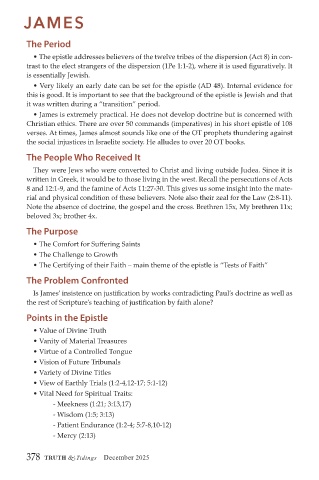
The Period

          • The epistle addresses believers of the twelve tribes of the dispersion (Act 8) in con-
        trast to the elect strangers of the dispersion (1Pe 1:1-2), where it is used figuratively. It
        is essentially Jewish.
          • Very likely an early date can be set for the epistle (AD 48). Internal evidence for
        this is good. It is important to see that the background of the epistle is Jewish and that
        it was written during a “transition” period.
          • James is extremely practical. He does not develop doctrine but is concerned with
        Christian ethics. There are over 50 commands (imperatives) in his short epistle of 108
        verses. At times, James almost sounds like one of the OT prophets thundering against
        the social injustices in Israelite society. He alludes to over 20 OT books.

        The People Who Received It
          They were Jews who were converted to Christ and living outside Judea. Since it is
        written in Greek, it would be to those living in the west. Recall the persecutions of Acts
        8 and 12:1-9, and the famine of Acts 11:27-30. This gives us some insight into the mate-
        rial and physical condition of these believers. Note also their zeal for the Law (2:8-11).
        Note the absence of doctrine, the gospel and the cross. Brethren 15x, My brethren 11x;
        beloved 3x; brother 4x.
        The Purpose
          • The Comfort for Suffering Saints
          • The Challenge to Growth
          • The Certifying of their Faith – main theme of the epistle is “Tests of Faith”
        The Problem Confronted

          Is James’ insistence on justification by works contradicting Paul’s doctrine as well as
        the rest of Scripture’s teaching of justification by faith alone?

        Points in the Epistle
          • Value of Divine Truth
          • Vanity of Material Treasures
          • Virtue of a Controlled Tongue
          • Vision of Future Tribunals
          • Variety of Divine Titles
          • View of Earthly Trials (1:2-4,12-17; 5:1-12)
          • Vital Need for Spiritual Traits:
               - Meekness (1:21; 3:13,17)
               - Wisdom (1:5; 3:13)
               - Patient Endurance (1:2-4; 5:7-8,10-12)
               - Mercy (2:13)

        378 TRUTH kTidings   December 2025

