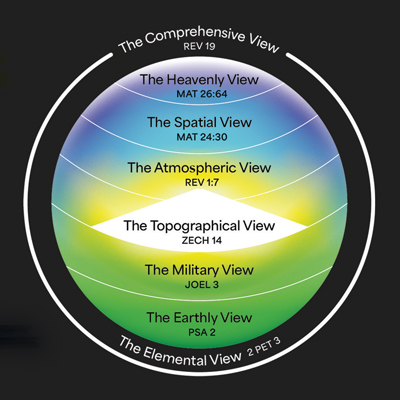
 Around the world, multitudes gathered to witness the glorious sight. On that day, January 28, 1986, my elementary school class sat in the cafeteria. A television had been wheeled out before us. We were meant to witness the glory of the space shuttle Challenger and the first time that a school teacher would be carried into orbit. But disaster struck. Just 73 seconds into flight, as its powerful rockets propelled toward outer space, that space shuttle and the seven members on board disintegrated into a plume of smoke. We sat in stunned confusion, and forty years later I have not forgotten the sight. The apostle John describes a future atmospheric wonder that no one will ever forget: “Behold, he cometh with clouds; and every eye shall see him, and they also which pierced him: and all kindreds of the earth shall wail because of him. Even so, Amen” (Rev 1:7).1
What will it be like in that future day when the whole world beholds, not a spacecraft seeking to leave our planet, but the Son of God entering our atmosphere with great power? Mankind will be transfixed by His unsurpassable glory. Souls will be astonished by His undeniable reality. Sinful hearts will rebel against His unconquerable authority. When Scripture describes His entrance into the first heaven, clouds and lightning are the details that mark His arrival. But we will see that the significance of these common atmospheric elements proclaims a far different reality from our everyday experience.
The cloud was present when Moses met the Lord on the mount; it led Israel in the wilderness, it filled the Temple, and it was present in the visions of Daniel and Ezekiel. But the cloud that marks God’s presence is not reserved alone for the Old Testament. Compare the Gospel accounts of the Mount of Transfiguration and you will find that the cloud of glory was present. In Luke’s account the cloud was so distinct that Peter, James and John were paralyzed with fear. Indeed, when the Lord ascended into heaven, “a cloud received him out of their sight” (Act 1:9). We should be clear that this cloud is no cirrus, cumulus or stratus. This is not a cloud to bring rain or shade, but it is the very cloud of heaven. Daniel said, “I saw in the night visions, and, behold, one like the Son of man came with the clouds of heaven, and came to the Ancient of days, and they brought him near before him” (7:13). Nahum humorously proclaims, “And the clouds are the dust of his feet” (1:3). We marvel at the beauty of a sunset as it paints the undersides of clouds with shades of pink and purple and red. But the clouds of heaven are far greater; as is this SON! They will not hide nor veil or dim His glory, but rather will enhance and accentuate the arrival of the Son of Shekinah glory in a way that will fill all the heavens.
The horizon that day will be as if Isaiah’s prophecy is being painted upon our atmosphere. “I am the LORD: that is my name: and my glory will I not give to another, neither my praise to graven images. Behold, the former things are come to pass, and new things do I declare” (Isa 42:8-9).
Luke emphasizes for us the second element that will define His return to the atmosphere as he records, “For as the lightning, that lighteneth out of the one part under heaven, shineth unto the other part under heaven; so shall also the Son of man be in his day” (Luk 17:24). We commonly think of lightning as that which travels down to earth from the clouds above with great rapidity. But please note that this description of lightning describes that which travels across the sky and in that way illuminates the entire atmosphere. So we appreciate that the cloud and the lightning emphasize to us that His return is an event that will fill all the heavens.
Over the centuries many have debated the phrase “every eye shall see him.” The concern has always been as to how it is possible for people living on every part of a round globe to all see the same sight at His appearance. Some have felt that man’s technology provides an answer. But do God’s purposes rely upon televisions and smart phones? Consider that even today 80% of people living in Papua New Guinea do not have a smart phone. John does not say that “most” eyes will see Him, but “every.” Additionally, consider that the events of the tribulation, such as the sun increasing its heat, will very likely destroy our beloved devices with electromagnetic radiation. So how is it possible that every eye will see Him?
The simple explanation is that He will come slowly, as a regal and military procession out of heaven. That arrival from the third to the second and into the first heaven may be long enough for the globe to rotate on its axis and thereby for every physical eye to see Him. Indeed, the description of the clouds and the lightning may serve to highlight how His arrival will fill the skies.
We could multiply words to seek to impress upon you the glorious display of the arrival of the Lord into the first heaven, but we would try in vain to attain the beauty with which the psalmist declares it: “Clouds and darkness are round about him: righteousness and judgment are the habitation of his throne. A fire goeth before him, and burneth up his enemies round about. His lightnings enlightened the world: the earth saw, and trembled. The hills melted like wax at the presence of the LORD, at the presence of the Lord of the whole earth. The heavens declare his righteousness, and all the people see his glory (Psa 97:2-6).
1 Bible quotations in this article are from the KJV.