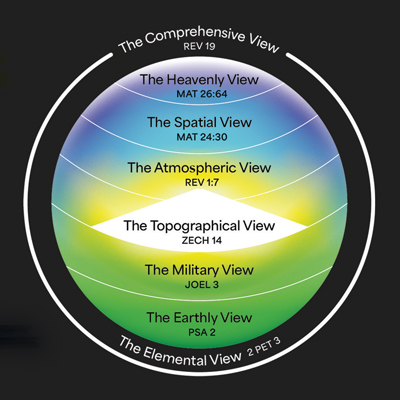
 “I knew a man in Christ above fourteen years ago, (whether in the body, I cannot tell; or whether out of the body, I cannot tell: God knoweth;) such an one caught up to the third heaven” (2Co 12:2).1 The verse evokes so many questions from the curious reader. Does Paul speak of himself or of another? When did this occur and what was the purpose of such a private vision? To a young believer, the thought of a first, second and third heaven can also be quite confusing. They need not be, since to an ancient believer it was a common way of describing the sky, the space beyond, and lastly the realm of God. Figuratively, the psalmist pictured God’s throne positioned above the stars and His feet extending down to touch the temple. “The LORD is great in Zion; and he is high above all the people. Let them praise thy great and terrible name; for it is holy …. Exalt ye the LORD our God, and worship at his footstool; for he is holy” (Psa 99:2-5). Isaiah echoes this viewpoint in stating, “Thus saith the LORD, The heaven is my throne, and the earth is my footstool: where is the house that ye build unto me? and where is the place of my rest? For all those things hath mine hand made, and all those things have been, saith the LORD: but to this man will I look, even to him that is poor and of a contrite spirit, and trembleth at my word” (Isa 66:1-2).
To be His footstool is not to be crushed by Him, but rather to surrender to His control. To tremble is to fear the Lord and faithfully follow His commands. Wonderfully, we are called to honor Him today with our obedience. In that great and future day, God will fulfill His promise of bringing all of creation into submission to His Son. “The LORD said unto my Lord, Sit thou at my right hand, until I make thine enemies thy footstool. The LORD shall send the rod of thy strength out of Zion: rule thou in the midst of thine enemies. Thy people shall be willing in the day of thy power, in the beauties of holiness from the womb of the morning: thou hast the dew of thy youth” (Psa 110:1-3). As the horizon of the second advent moves from the third heaven into time and space, it is evident that what is true in heaven is being brought to bear upon earth.
“Immediately after the tribulation of those days shall the sun be darkened, and the moon shall not give her light, and the stars shall fall from heaven, and the powers of the heavens shall be shaken: And then shall appear the sign of the Son of man in heaven: and then shall all the tribes of the earth mourn, and they shall see the Son of man coming in the clouds of heaven with power and great glory” (Mat 24:29-30). It doesn’t take much imagination to conclude that during the tribulation men will excuse many of the events of judgment as the terrible consequences of climate change. However, as the days of the tribulation progress, and the intensity of the judgment expands, any honest observer will have to recognize that what is happening does not involve just the earth and its atmosphere, but extends to the solar system and universe beyond. This universal effect must come from the hand of the Creator. Thus, it is not the fruit of crimes against the planet, but rather the righteous judgment of the Lord for sin against an offended God.
We have already considered the horizon of the third heaven as a doorway opened into the very throne room of God. Yet, just prior to that scene, in Matthew 24 the Lord Himself describes a sign that will appear in outer space. Far greater minds have debated what “the sign of the Son of man” might be. Some suggest that it is a renewed display of Shekinah glory preceding the arrival of Christ. Others offer that it may involve the emergence of the New Jerusalem. And still others say that the Lord Himself is the sign. Scripture does not give us the exact details, just its indubitability.
Consider for a moment the reactions of men to the cosmological sign at His first advent. For the majority it was ignored. For the wise men, likely following a tradition of scriptural study that went back to the days of Daniel, it was the motivation for a great act of worship. Those men traveled far, they sought diligently, and they worshiped deeply and generously. We too, after making a great journey as the Bride of Christ, will see His sign and worship His person. While some worshiped at His first advent, others responded violently and wickedly. Sadly, this will be true again at His second advent. The sign of the Son of man, rather than serving as a reason for repentance, will instead inspire unified rebellion and rejection, just as was seen at the cross.
But try as they might, the Christ-rejectors upon earth will have no power to slow the approach of the glorious Lord. “Who is this King of glory? The LORD strong and mighty, the LORD mighty in battle. Lift up your heads, O ye gates; even lift them up, ye everlasting doors; and the King of glory shall come in. Who is this King of glory? The LORD of hosts, he is the King of glory. Selah” (Psa 24:8-10).
1 Bible quotations in this article are from the KJV.