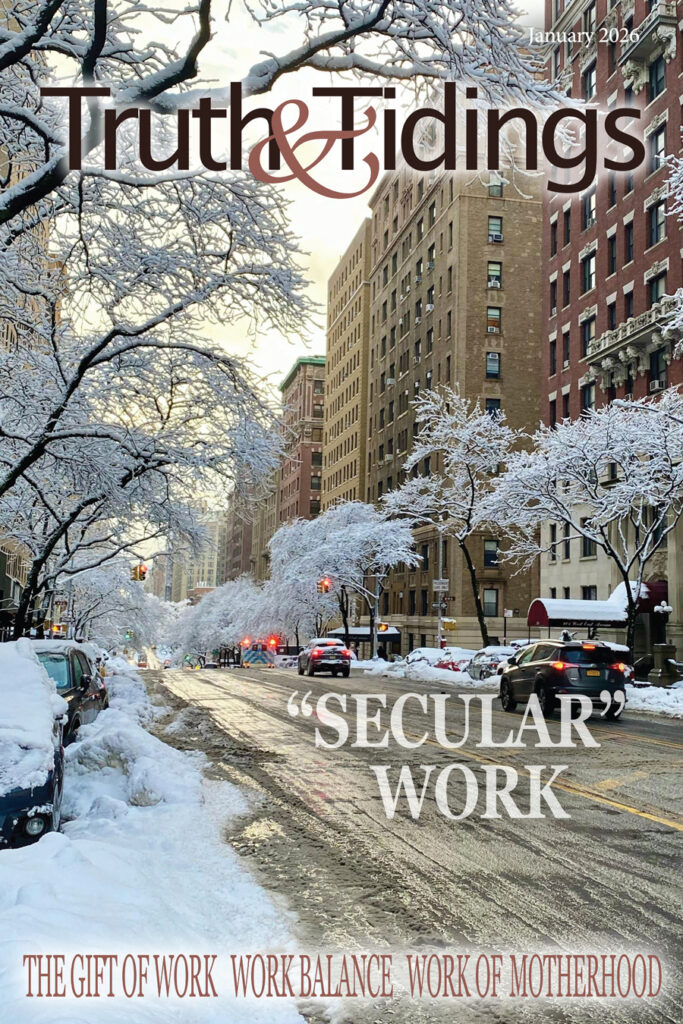
About 20 of the 24 hours in our day are spent either sleeping, preparing (and eating) meals or working. The use of the other few hours tends to be the focus of our sermons – how we gather as an assembly, our gospel outreach, mentoring, encouraging fellow believers, etc. But more than anything else, sleeping, eating and working soak up most of our time. Yet when was the last sermon you heard on eating (or overeating)? The Bible has much to say about it. And what about sleeping (or rest)? How many messages can you recall that were devoted to this subject?
Arguably, the largest percentage of our time is spent working, including transportation to and from our jobs. Even with remote work being a possibility for some, the average number of hours worked per weekday in my country is 8.4.1 So, when was the last time you heard a sermon about work – not “work for the Lord” but secular work? Indeed, Scripture has much to say about this also. And what we’ll learn in this special issue is that our secular work actually is “work for the Lord.” For the Christian, secular service is transformed into spiritual service.
Our writers this month helpfully show us from God’s Word that we were created and fitted for work. “The LORD God took the man and put him in the garden of Eden to work it and keep it” (Gen 2:15 ESV). After the Fall, work became increasingly difficult. Therefore, Scripture contains many warnings about neglecting our work and relying on others to do it for us. There is also the need to balance our work with rest and with other responsibilities so as not to make work (including the obsession with making money) an idol.
We will also be taught that when our work is done well, it can be a platform for evangelism as we “adorn the doctrine of God our Savior” (Titus 2:10 KJV). Working with our eyes up, realizing that our heavenly Master is watching, will help us to that end as well as remind us that He will reward us for the way we work – a compensation far more significant than our regular paycheck.
Principles from the life of our Savior will also instruct us as we note how He worked as Creator before He came to earth and as Carpenter while here.
The valuable work of motherhood is also taught in Scripture and clearly explained in this issue. Don’t skip the profitable article on retirement and how to spend it. And speaking of spending, Paul told the Ephesian believers they could spend some of their compensation helping those in need – a good way to avoid the trap of self-centeredness. This is something Paul lived out (see Act 20:34-35).
Prophetic passages show us that when this life is over, our work will not be. We will have work to do during the Millennial Reign of Christ and beyond: “His servants shall serve him” (Rev 22:3 KJV). Thankfully, working conditions will improve exponentially and, as we will be in glorified bodies, so will our productivity.
John Ruskin once said, “The highest reward for a man’s toil is not what he gets for it, but what he becomes by it.” The way I work is making me a certain kind of person. May I determine to ensure it’s one who is adorning well the doctrine of God my Savior.
1 Statista Research Department, accessed 12/03/2025.